
In the months after a spinal cord injury, a rehabilitation hospital does essential work. Then you go home, the formal program winds down, and the questions start. Can I get stronger? Could transfers take less out of me? Is standing, or even walking, still on the table? At Revivo, we work with adults in Toronto and across the GTA who want to keep building function after a spinal cord injury, and we try to answer those questions honestly rather than hopefully.
Understanding spinal cord injury
The spinal cord carries messages between the brain and the rest of the body. When it is damaged, signals below the injury are partly or completely interrupted, which affects movement, sensation and many automatic body functions.
Injuries are either traumatic, from a fall, collision, diving or sports accident, or violence, or non-traumatic, from causes such as spinal stenosis pressing on the cord, tumours, infection, inflammation or a disrupted blood supply.
Two details shape what rehabilitation can realistically achieve:
- Level. An injury in the neck (cervical) can affect the arms, trunk and legs, called tetraplegia. An injury lower down affects the trunk and legs, called paraplegia.
- Completeness. In a complete injury, no movement or sensation is preserved at the very lowest part of the spinal cord. In an incomplete injury, some signals still get through. Your rehab team may have described this using the ASIA scale, from A (complete) to E (normal function).
Most neurological recovery happens within the first year or so. After a complete injury, meaningful return of movement below the injury is uncommon, so rehab focuses on making the most of everything that works. Incomplete injuries vary far more: some people regain substantial strength and walking ability, others less. In both cases, strength, fitness and skill can keep improving long after that first year.
How a spinal cord injury affects daily life
The effects reach well beyond the legs. Depending on level and completeness, people commonly live with:
- Weakness or paralysis, and reduced trunk control for sitting balance
- Loss of sensation, which puts skin at risk of pressure injuries
- Spasticity and spasms that can help with some tasks and get in the way of others
- Changes in bladder, bowel and sexual function
- Blood pressure that drops on sitting up or standing, and for injuries at T6 (mid-chest) or above, a risk of autonomic dysreflexia
- Nerve pain, and shoulder strain from years of pushing a wheelchair and transferring
- Bone thinning below the injury and a gradual loss of fitness
How Revivo approaches spinal cord injury
Our core program for spinal cord injury is Intensive Suit Therapy, and the emphasis is squarely on function. The suit is a soft dynamic proprioceptive orthosis: a vest, shorts, knee pads, shoe attachments and a cap linked by elastic bungee cords. It traces back to the "Penguin" loading suit designed for cosmonauts, whose bodies lost the loading gravity normally provides. After a spinal cord injury the legs and trunk lose much of that loading too; the suit adds external support so you can work in positions you can't yet hold alone.
In practice, that means:
- Stability where you need it. The cords support the trunk and hips, so you can work on tall kneeling, sitting balance or supported standing with better alignment.
- Isolated strengthening. In the Universal Exercise Unit, pulleys and weights let your therapist target individual muscles. With an incomplete injury, that can mean coaxing more out of partly working muscles. With a complete injury, it means building the shoulders, arms and any trunk muscles you control, which do the heavy lifting in transfers and wheelchair use.
- Supported stepping. For some incomplete injuries, suspension lets you practise standing and stepping with part of your body weight supported, so the focus stays on quality movement rather than bracing against a fall.
Suit therapy does not repair the spinal cord, and we won't suggest otherwise. What it offers is a concentrated stretch of high-repetition, function-focused work. Physiotherapy, massage for comfort and muscle tightness, and acupuncture are available as supporting therapies.
Some people ask about Hyperbaric Oxygen Therapy (HBOT). Health Canada recognizes 13 conditions for HBOT, such as decompression sickness, carbon monoxide poisoning and diabetic foot ulcers, and spinal cord injury is not among them. At Revivo it is a complementary option only, not a core treatment for spinal cord injury.
What a program looks like
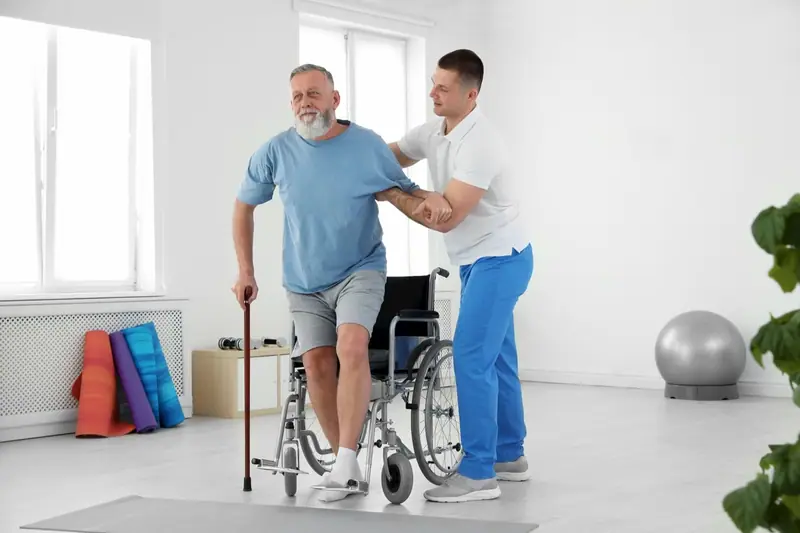
A standard block is 3–4 hours a day, 5 days a week, for 3–4 consecutive weeks, delivered by specially trained physiotherapists and customized after a roughly one-hour assessment. A typical day follows this pattern, adapted to your level of injury:
Warm-up and positioning
Hot packs and deep-pressure massage for 30–45 minutes to ease tone and spasm before you start working.
Suit application
About 10–15 minutes to fit the suit and set cord tension around your posture, injury level and comfort.
Targeted strengthening
Up to an hour in the Universal Exercise Unit on the muscles that matter most for your transfers, sitting balance or stepping.
Functional practice
Up to an hour on real tasks: transfers, sit-to-stand, parallel-bar work, supported standing and, where appropriate, assisted walking.
Cool-down
Suit removal and stretching over 10–15 minutes, a good moment to check your skin and plan what to practise at home.
Realistic goals: function, strength and independence
Goals are set with you at the assessment and depend heavily on your injury level and completeness. Common ones include:
Safer, easier transfers
Moving between bed, wheelchair, car and toilet with less effort, less help and less strain on the shoulders.
Sitting balance and trunk control
Reaching, dressing and leaning without losing your balance, which makes daily tasks quicker and safer.
Upper-body strength
Stronger, better-balanced shoulders and arms for pushing, lifting and transferring for years to come.
Standing and stepping
Supported standing for many people; for some with incomplete injuries, practice toward walking with aids.
Walking is a fair question to ask, and for some people with incomplete injuries it is a realistic goal to work toward. For many others, especially after a complete injury, the biggest gains in daily life come from stronger transfers, better sitting balance and less pain. We'll tell you which picture fits your assessment, and help you pursue it.
Safety and suitability
Spinal cord injury brings specific risks, so screening is thorough. We recommend involving your physiatrist, surgeon or family physician, and we may need their clearance, particularly regarding:
- Spinal stability. Any surgical hardware and restrictions on bending, twisting or loading must be confirmed first.
- Bone health. Bones below the injury often thin over time, which raises fracture risk during standing and loaded exercise.
- Skin. Where sensation is reduced, you may not feel straps rubbing, so skin should be checked before and after every session.
- Blood pressure. Standing can cause light-headedness, so positions should change gradually.
- Bladder and bowel routines need to be planned around longer sessions.
If you do consider HBOT, ear discomfort is the most common side effect (swallowing or yawning helps equalize pressure). Temporary near-sightedness can develop over a course, and there is a rare risk of seizure, reduced with lower pressures and shorter sessions. Remember that it is complementary only, since spinal cord injury isn't a Health Canada-recognized HBOT use.
If your injury is at T6 or above, a pounding headache, flushing or sweating above the injury, a stuffy nose or a sudden rise in blood pressure can signal autonomic dysreflexia. Sit upright, loosen anything tight and look for the trigger, often a full bladder. If it doesn't settle quickly, treat it as an emergency and call 9-1-1.
Frequently asked questions
Can suit therapy help me walk again?
It depends on your injury. For some people with incomplete injuries, walking with aids is a realistic goal to work toward. After a complete injury it rarely is, and we'll focus on transfers, sitting balance and strength.
Is it worthwhile with a complete injury?
It can be. Stronger shoulders, better trunk control and smoother transfers can make a real difference to daily independence, even when movement below the injury doesn't return.
What does it cost?
Phone and in-person consultations are free. The intake assessment takes about an hour and costs $100 CAD, and suit therapy is billed at $122 CAD per hour of therapy, so the total depends on your approved protocol. HBOT, if you choose it, starts from $79 per session. A significant portion may be claimable through extended health or private insurance because care is delivered by registered therapists.
How long until we see change?
Recovery after a spinal cord injury is often slow. Some people notice small gains in strength, balance or ease of transfers during a 3–4 week block; others find the benefits build across several blocks with regular home practice. Results vary, and none are guaranteed.
How long after my injury can I start?
Once your spine is stable and your medical team has cleared you for more intensive activity. Some start soon after inpatient rehab; others years later.
Medical note: this page is general information, not medical advice. Every person is different and progress varies. Please involve your family physician or specialist when planning therapy. Hyperbaric oxygen is offered at Revivo as a complementary therapy; neurological conditions are not among the 13 HBOT indications currently recognized by Health Canada.