
Intensive Suit Therapy in Toronto
Physiotherapy with a boost. A soft, wearable suit realigns the body while our specially trained physiotherapists guide hours of focused, repetitive practice — concentrated work that helps children and adults with neurological conditions build real, everyday skills.
See Intensive Suit Therapy at Revivo
Nine videos filmed in our clinic with the families' permission — real therapy sessions, and parents describing the changes they saw in their own words. Choose any video from the list to play it.
9 videos · filmed at Revivo
Therapy sessions
Parents in their own words
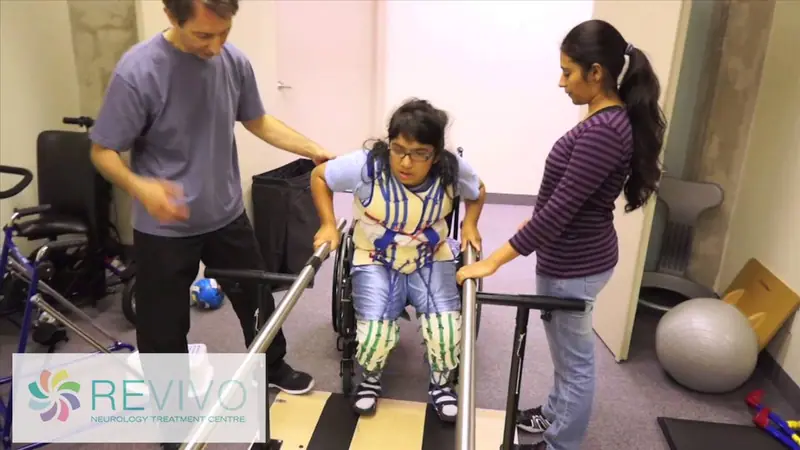
An external skeleton that helps the brain relearn movement
Intensive Suit Therapy — also known as the TheraSuit Method or the Adeli method — uses a breathable, soft dynamic proprioceptive orthosis: a vest, shorts, knee pads, shoe attachments and a cap connected by adjustable elastic cords. Once fitted, the suit holds the body as close to typical alignment as possible, restoring correct posture and weight-bearing so that every movement sends clearer feedback to the brain.
The idea began in space. In the 1970s, engineers designed the "Penguin" loading suit to protect cosmonauts' muscles and bones from the effects of weightlessness. Physicians later adapted it for children with cerebral palsy, and the TheraSuit Method grew from that work into a structured, intensive physiotherapy protocol now used around the world.
The suit is only half of the story. What makes the method work is intensity and repetition: specific exercises, repeated many times, with carefully chosen resistance, over several consecutive weeks. That combination of better alignment, richer sensory input and concentrated practice is what families describe as "physio with a boost."
Six parts, one connected system
Each piece of the suit links upper body to lower body and left side to right side. Your physiotherapist adjusts the elastic cords to correct each person's specific patterns.
Vest
Anchors the trunk and shoulders, giving a stable core that the arms, hips and legs can work from.
Shorts
Position the pelvis and hips, the foundation for sitting balance, standing and a more even gait.
Knee pads
Guide knee alignment and help control the inward turning or hyperextension that disrupts standing and walking.
Shoe attachments
Connect the feet to the system so ankles and feet are loaded in a more functional position.
Cap
Links the head to the trunk to encourage better head position and control during movement.
Elastic cords
Realign the body and add gentle load, increasing the sensory and vestibular feedback sent to the brain with every movement.
The result is what physiotherapists call proprioceptive input — the body's sense of where it is in space. Many children with neurological conditions receive confusing or weak signals from their muscles and joints. By loading the body in a more typical position, the suit helps turn reflexive, inefficient patterns into deliberate, functional movement that can become automatic over time.
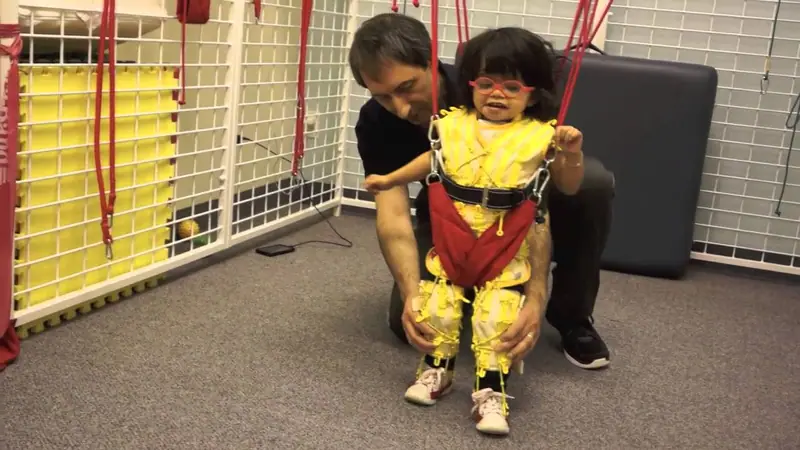
The Universal Exercise Unit — our "spider cage"
Alongside the suit, we use the Universal Exercise Unit: a frame with a pulley and weight system that lets your therapist isolate one muscle group at a time. Weak muscles get targeted strengthening, tight muscles get controlled range-of-motion work, and the exercises are built around the functional movements that matter in daily life.
In the suspension ("spider") set-up, elastic bungees support part of the body's weight. That lets a child practise standing, kneeling, squatting, stepping and even jumping safely — positions they might not yet manage on their own — so the nervous system gets the repetition it needs to learn.
- Isolated strengthening with pulleys and graded weights
- Supported standing, balance and weight-shifting
- Assisted walking, stand-ups, parallel bars and tricycle riding
What three to four hours actually looks like
Every exercise, repetition count and resistance level is customized after your assessment. A typical session day runs Monday to Friday between 9am and 6pm, scheduled around your approved treatment plan.
- 30–45 minWarm-up
Hot packs, deep-pressure massage and warm-up
Muscles are prepared with heat and deep pressure, followed by moderate warm-up exercises so the body is ready for focused work.
- 10–15 minSuit on
Fitting the suit
The therapist puts on the suit and adjusts each elastic cord to correct that person's alignment for the day's goals.
- Up to 1 hrStrength
Isolated strengthening in the Universal Exercise Unit
Pulleys, immobilizers and weight loads target the specific muscle groups behind sitting, standing and walking.
- Up to 1 hrFunction
Dynamic, functional movement
Suspension work, assisted walking (suspended and on the floor), push-ups, stand-ups, parallel bars, tricycle riding and play-based tasks that turn new strength into skills.
- 10–15 minCool-down
Cool-down and suit removal
Gentle stretching and a calm finish. Parents get a quick update on the day and ideas for practising at home.
Built for neurological conditions that affect movement
Most of the families we see have a child with cerebral palsy, but suit therapy is also used for acquired brain injury, post-stroke recovery, ataxia, developmental delays, autism spectrum disorder with motor challenges and other neuromuscular conditions — in children, teens and adults.
Cerebral Palsy
Building posture, movement and independence
Learn moreBrain Injury (ABI & TBI)
Rebuilding skills after an injury
Learn morePost-Stroke Recovery
Regaining strength, balance and function
Learn moreAtaxia
Improving balance and coordination
Learn moreSpasticity
Easing stiffness, improving control
Learn moreAthetosis
Steadier, more purposeful movement
Learn moreSpinal Cord Injuries
Strength, transfers and independence
Learn moreMuscular Dystrophy
Protecting comfort, range and function
Learn moreWhat families work toward
Goals are set together at the intake assessment and reviewed throughout the block. Because the work is so concentrated, many parents notice changes within the first one to two weeks — and by the third week most can point to something concrete. Every person progresses differently.
Head & trunk control
Holding the head up and keeping the body steady — the base for everything else.
Sitting independently
Sitting longer and more safely, freeing the hands for play and daily tasks.
Rolling, crawling & kneeling
Transitional movements that build strength and independence on the floor.
Standing & walking
Weight-bearing, stepping and gait with less support and better alignment.
Balance & coordination
Steadier movement and better reactions when the body is challenged.
Using both hands
More purposeful reaching, grasping and two-handed play.
Tone & flexibility
Moving with less stiffness and protecting range of motion in the joints.
Confidence
Children who feel capable try more — often the change parents mention first.
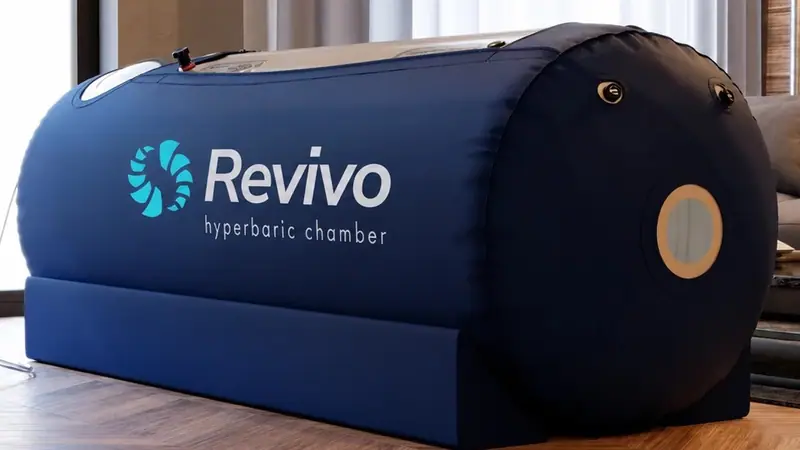
Pair suit therapy with hyperbaric oxygen
Many families combine an intensive suit block with Hyperbaric Oxygen Therapy. HBOT sessions are scheduled around suit sessions, so the extra oxygen supports a body that is working hard every day. Revivo offers a combined Suit Therapy + HBOT package, and families who want to continue HBOT after the block can rent a chamber for home.
- One coordinated schedule and one care team
- Package pricing for combined programs
- Continue HBOT at home with a rental chamber
Clear pricing from the first call
Your total depends on the protocol approved after assessment — the number of hours per day and the number of weeks. For planning, a three-week block at three hours a day is 45 therapy hours.
Consultation
Talk to us by phone or in person about your child's history, goals and whether suit therapy is a good fit. No cost, no obligation.
Intake assessment
About an hour with our therapists. You'll get a detailed picture of what to expect from therapy, clear goals and a recommended protocol.
Intensive Suit Therapy
Billed per hour of therapy according to your approved, individualized protocol. Combined Suit + HBOT packages are available.
Every intensive program starts with our Health Information Form and recent MRIs or x-rays.
Because therapy is delivered by registered and certified therapists, a significant portion of the cost can often be claimed under extended health care plans or private medical insurance. We provide detailed receipts. Some plans ask for a physician's referral before reimbursing physiotherapy, so it's worth checking your policy before you start.
Is suit therapy right for your child?
Intensive work is demanding, so suitability is decided individually. At the intake assessment we review medical history, current abilities, endurance and goals, and we recommend whether a full-day protocol is appropriate or whether shorter days make more sense to start.
We also keep your family physician or specialist in the loop. Some conditions need medical clearance or a modified program, and a few mean suit therapy isn't the right choice right now.
Hip subluxation or dislocation, seizures that aren't well controlled, heart or breathing conditions, high blood pressure, a shunt, significant scoliosis, recent surgery or orthopaedic procedures, and any recent changes in health. These don't always rule therapy out, but they shape the plan.
Snug, comfortable clothing (a fitted T-shirt and leggings or shorts), socks and supportive shoes, a water bottle and snacks — plus a favourite toy, song or reward. Children work hardest when therapy feels like play.
What suit therapy families say
“We can now for the first time witness BIG CHANGES in our son in just the last 4 months, whereas we saw only little progress in his development during all of the first 4 years of his young life.”
“The suit, which was worn 80% of the time, provided Thomas with added balance, coordination and more independence! … Thomas was more limber and he clearly enjoyed the freedom of not being held and guided during movement.”
“It is rare to bring him into a place where he needs to work very hard and he is smiling and laughing. Our goals when we began were to see improvement on current skill sets and hopefully gain new skills.”
Reading for families
Articles from our team on cerebral palsy, development and recovery.
Physiotherapy for Stroke Survivors: A Path to Recovery
Stroke can be a life-altering event, affecting not just the physical capabilities of survivors but also their independence, emotional well-being, and…
Stroke RecoveryHow Your Diet Can Aid Post Stroke Therapy
How a balanced, specialized diet can support stroke recovery and physiotherapy — key nutrients, foods to favour and practical tips from Revivo, Scarborough.
Conditions & FamiliesMaking Your Home Conducive For A Child With Cerebral Palsy
Living with a child with cerebral palsy can pose certain challenges, especially if your home is not adapted to the special needs of the child. Modifying…
How long is an Intensive Suit Therapy program?
The standard protocol is three to four hours of therapy a day, five days a week, for three to four consecutive weeks. Your therapist may recommend a shorter daily schedule to start if endurance is a concern, and the plan is adjusted as the block progresses.
How soon will we see results?
Because the therapy is so concentrated, many families notice changes within the first one to two weeks — often in head and trunk control, posture, tone or confidence — and by the end of the third week most parents can describe clear progress. How much changes, and how quickly, depends on the person and the condition, so we set realistic goals at the assessment and review them as you go.
What does suit therapy cost, and is it covered by insurance?
Consultations are free. The intake assessment takes about an hour and costs $100. Therapy is billed at $122 per hour according to your approved protocol. Because it's delivered by registered therapists, a significant portion may be claimable under extended health or private insurance plans — check whether yours requires a physician's referral.
Do we need a doctor's referral?
No referral is needed to book a consultation or assessment with us — physiotherapy is directly accessible in Ontario. We do encourage you to keep your physician or specialist informed, and some insurance plans require a referral before they reimburse.
How old does my child need to be?
We work with young children, school-age children, teens and adults. Readiness depends more on the person than on age alone, which is why the intake assessment matters: it tells us whether a full-day protocol is appropriate and how to pace it.
Can we do more than one block?
Yes. Many families return for repeat cycles. Spacing blocks apart gives new skills time to consolidate at home and in daily life; your therapist will suggest timing based on progress and goals.
Can suit therapy be combined with Hyperbaric Oxygen Therapy?
Yes — Revivo offers a combined Suit Therapy + HBOT package, with HBOT sessions scheduled around the suit sessions. Learn more on our HBOT page, or ask about renting a chamber to continue at home.
Is suit therapy safe?
When it's delivered by trained therapists after a proper assessment, suit therapy is a well-established approach. The work is physically demanding, so we screen for conditions that need medical clearance or a modified program, monitor fatigue closely and adjust the load every day.
Ready to see what three focused weeks can do?
Book a free consultation and we'll talk through your child's goals, the program and the costs — then you decide.